
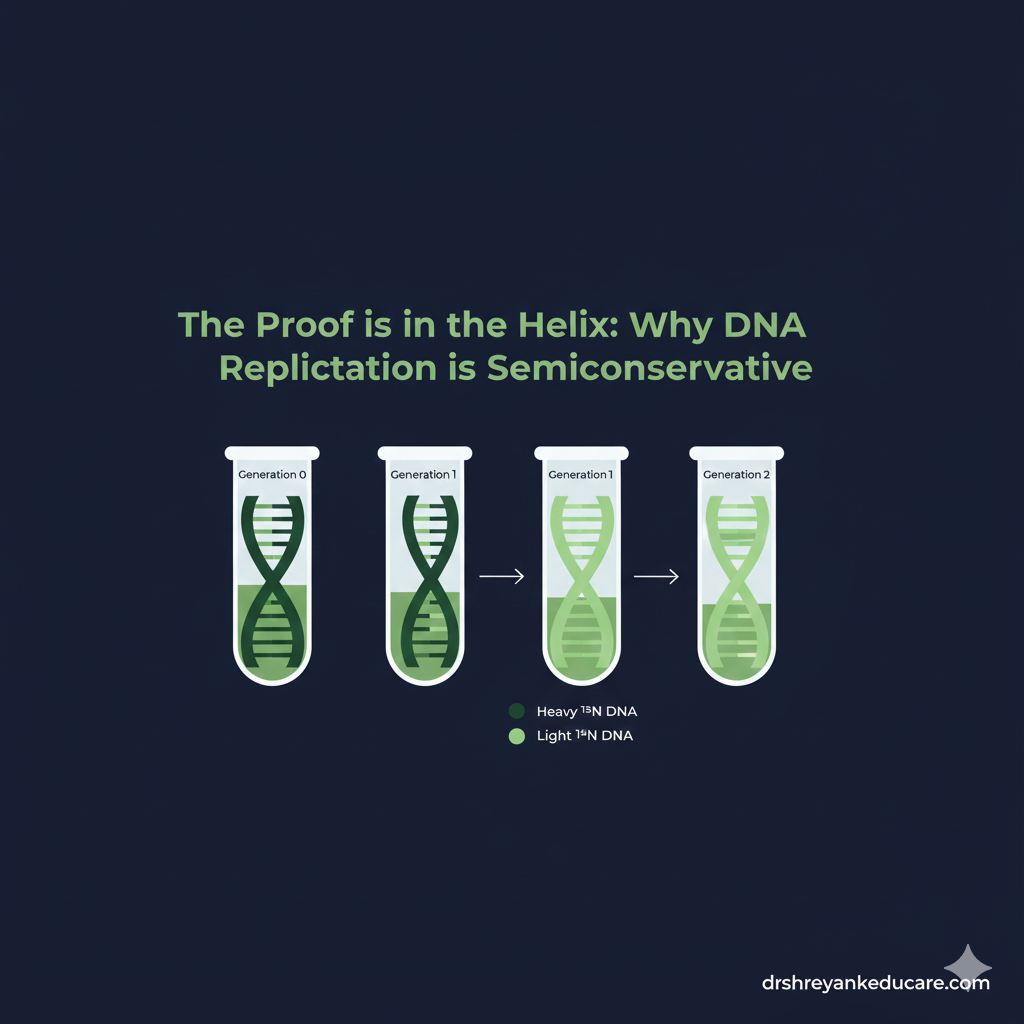
The Proof is in the Helix: Why DNA Replication is Semiconservative
How We Know DNA Replicates Semiconservatively: The Meselson–Stahl Experiment (Explained Simply)
When James Watson and Francis Crick revealed the structure of the DNA double helix, a new question appeared instantly: How does this structure copy itself so accurately?
The answer—semiconservative replication—is one of biology’s most elegant ideas. However, proving it required one of the most brilliant experiments in science: the Meselson–Stahl Experiment.
If your textbook jumps straight into the DNA replication fork without explaining the “why,” you’re missing the essential proof. This guide explains the three proposed models of replication and the experiment that settled the debate forever.
For help with related Biology concepts, visit our Biology Tutoring page.
The Three Models: How Scientists Thought DNA Might Copy Itself
Before DNA’s structure was confirmed, researchers proposed three possible replication mechanisms. Each attempted to explain how strands of DNA could act as templates.
1. The Conservative Model
The conservative model suggested that the parent double helix stayed completely intact. According to this idea:
- The original two strands remained paired.
- The cell created an entirely new double helix made of two new strands.
As a result, one DNA molecule would be 100% old, and the other would be 100% new.
2. The Dispersive Model
The dispersive model claimed that DNA broke into pieces during replication. After rebuilding:
- Each new molecule would be a mix of old and new DNA segments.
- Both daughter molecules would be patchworks of old and newly synthesized DNA.
Because the old DNA would be “dispersed” throughout the resulting strands, no strand would remain fully intact.
3. The Semiconservative Model (Watson & Crick’s Prediction)
Watson and Crick predicted a different mechanism that matched the structure of the double helix:
- The two parent strands separate.
- Each parent strand serves as a template for a new complementary strand.
- Each daughter DNA molecule contains one old (parent) strand + one new (daughter) strand.
This is why the process is called semiconservative—half of the original structure is conserved in every new copy.
The Meselson–Stahl Experiment: The Elegant Proof (1958)
In 1958, Matthew Meselson and Franklin Stahl designed an experiment so clear and clever that it is often called the most beautiful experiment in biology.
They used isotopes of nitrogen to track old and new DNA strands.
Their strategy allowed them to distinguish between all three replication models.
The Key Ingredients
Heavy Nitrogen (¹⁵N)
Meselson and Stahl grew E. coli in a medium containing heavy, non-radioactive ¹⁵N.
Since nitrogen is part of every DNA base, the bacteria built heavy DNA.
Light Nitrogen (¹⁴N)
Next, they transferred the bacteria into a normal medium containing ¹⁴N.
Any new DNA made in this medium became light DNA.
Density-Gradient Centrifugation
Using high-speed centrifugation, they separated DNA by density:
- Heavy DNA sinks lower in the tube.
- Light DNA stays higher.
- Hybrid DNA forms intermediate bands.
The Results That Changed Biology Forever
1. After Generation 1 (One Round of Replication)
The DNA formed one intermediate band, halfway between heavy and light.
Meaning:
Every DNA molecule contained one heavy strand and one light strand.
✔ This eliminated the Conservative Model immediately.
If the conservative model were correct, we would have seen two bands: one heavy and one light.
2. After Generation 2 (Two Rounds of Replication)
Two distinct bands appeared:
- One intermediate band (Heavy/Light)
- One light band (Light/Light)
Meaning:
This pattern ruled out the Dispersive Model, which predicted only a single blended band.
The two-band result matched only one model: Semiconservative replication.
Why This Matters for the DNA Replication Fork
The Meselson–Stahl experiment proved that each parent strand serves as a template.
This discovery is the foundation for the entire mechanism at the DNA Replication Fork, where:
- Helicase unzips the parent strands
- SSB proteins stabilize the open DNA
- Primase adds primers
- DNA Polymerase builds new complementary strands
- Ligase seals any gaps
To review the replication fork step-by-step, you can revisit our post on DNA Replication Fork Explained Simply.
Because each parent strand guides the formation of a new strand, every daughter DNA molecule ends up half old and half new—just as Meselson and Stahl demonstrated.
Master Biology With Clarity
If complex genetics topics still confuse you, you don’t need to memorize diagrams. Understanding the logic behind these experiments will help you score higher on exams and build real confidence.
We offer 1-on-1 Biology + Science tutoring for Grade 6–12 and university students.
📞 672-514-7587
🌐 drshreyankeducare.com
🎉 First class only $10