

College entrance exam prep for Canadian students 2026
Estimated reading time: 11 minutes
Tackling college entrance exams in math and science can feel overwhelming, especially when you’re unsure how to study effectively. Many Canadian high school students struggle with confidence and preparation, leaving marks on the table. This college entrance exam guide delivers a clear, step-by-step plan using personalised tutoring and targeted practice to boost your scores and build exam-ready confidence.
Table of Contents
- Introduction To Canadian College Entrance Exams In Math And Science
- Prerequisites: What You Need Before Starting Exam Preparation
- Step-By-Step Preparation Plan For Math And Science Exams
- Choosing The Right Tutoring Method And Resources
- Common Mistakes To Avoid And How To Fix Them
- Expected Timelines And Measuring Your Progress
- Boost Your Exam Success With Expert Tutoring
- Frequently Asked Questions
Key takeaways
| Point | Details |
|---|---|
| Personalised tutoring drives results | One-on-one sessions improve scores by 10-20% within 8-12 weeks through focused attention on weak areas. |
| Targeted practice beats cramming | Consistent preparation over 4-6 months with weekly practice tests yields better outcomes than last-minute study. |
| Diagnostic testing is essential | Baseline assessments identify specific knowledge gaps to create a tailored study plan. |
| Choosing the right tutoring matters | One-on-one tutoring is 25% more effective than group sessions for exam score gains. |
Introduction to Canadian college entrance exams in math and science
Canadian college entrance exams test your mastery of core math and science concepts aligned with provincial curriculum standards. Understanding what’s on these exams helps you focus your preparation where it counts most.
Math topics dominate many entrance exams. You’ll face algebra problems, calculus questions, geometry proofs, and statistics applications. Exams emphasise core math topics such as algebra, calculus, and geometry aligned with provincial standards, so your high school coursework directly prepares you. Science sections cover biology, chemistry, and physics, testing both conceptual understanding and problem-solving skills.
Key exam characteristics include:
- Multiple-choice and written response formats that test both speed and depth
- Time constraints requiring efficient problem-solving strategies
- Content reflecting provincial learning outcomes and standards
- Emphasis on application rather than pure memorisation
Knowing the exam structure lets you practise under realistic conditions. Past papers reveal question patterns and difficulty levels. Provincial exam standards and content vary slightly, so confirm which version applies to your target institution.
Prerequisites: what you need before starting exam preparation
Successful exam prep starts with the right foundation. Before diving into intensive study, you need to assess your current level, gather tools, and establish productive habits.
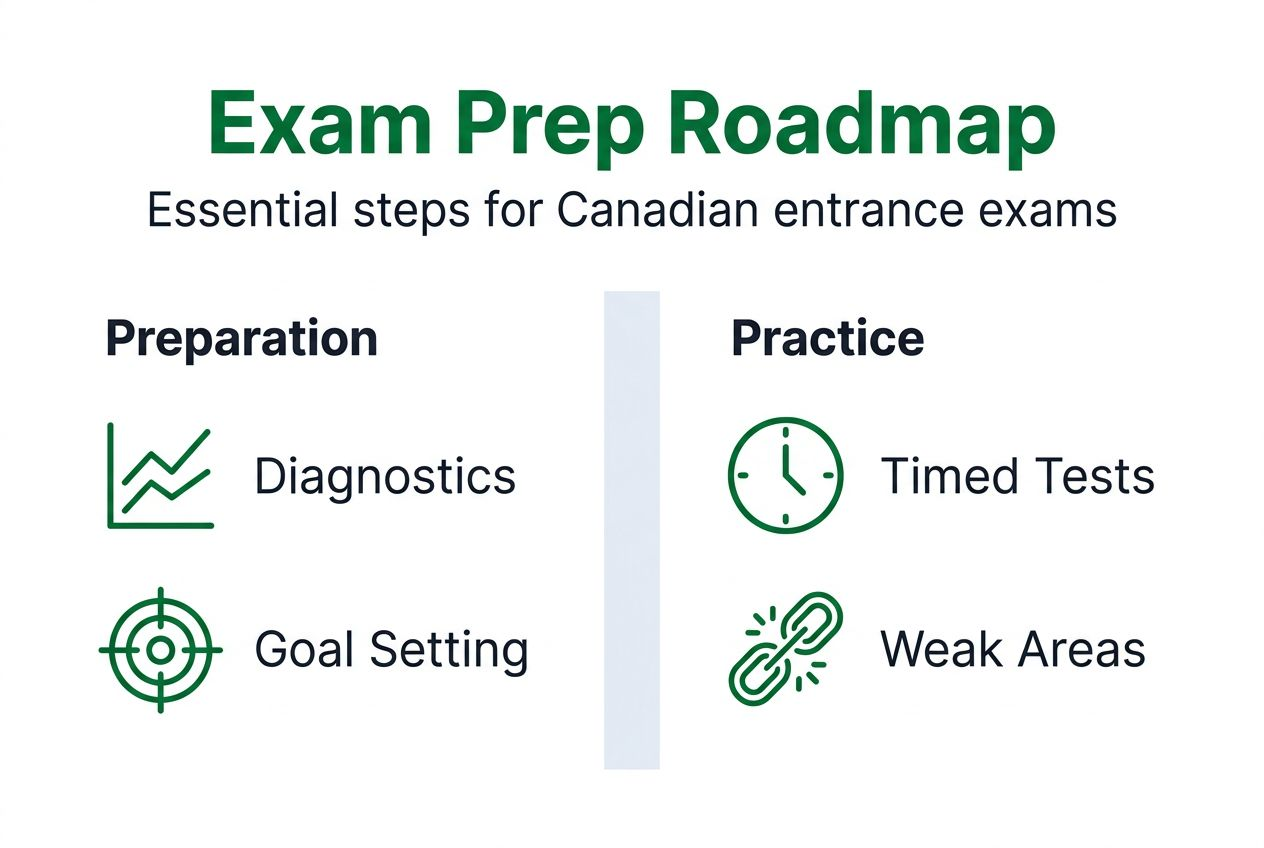
Baseline diagnostic testing identifies specific weaknesses to tailor study plans, revealing exactly which topics need attention. Take a practice exam under timed conditions to benchmark your starting point. This honest assessment prevents wasted time reviewing material you already know.
Essential tools and resources include:
- Scientific calculator approved for your exam format
- Reference materials covering formulas and key concepts
- Study planner or calendar for scheduling sessions
- Quiet workspace free from distractions
- Access to past exam papers and practice questions
You’ll need solid foundational knowledge too. Algebra skills like solving equations and manipulating expressions are non-negotiable. Basic science literacy in biology, chemistry, and physics principles helps you build advanced understanding quickly.
Goal setting transforms vague intentions into concrete targets. Define your score goals based on admission requirements for your chosen programmes. Break these into monthly milestones to track progress. Time management becomes critical when balancing exam prep with schoolwork and other commitments.
Pro Tip: Schedule your diagnostic testing for exam prep at least 5 months before exam day to allow sufficient time for improvement without rushing.
Step-by-step preparation plan for math and science exams
A structured approach turns preparation from overwhelming to manageable. Follow these six steps to build knowledge systematically and track your improvement.
-
Complete a diagnostic test covering all exam topics. Score it honestly and list every concept that caused difficulty. This creates your personalised weakness map.
-
Develop a study plan targeting your weakest areas first. Allocate more hours to challenging topics like calculus or organic chemistry. Schedule review sessions for stronger areas to maintain skills.
-
Begin regular one-on-one tutoring focused on problem-solving mastery. Personalised tutoring combined with consistent practice improves scores by 10-20% within 8-12 weeks, making it the most effective intervention. Your tutor explains difficult concepts, demonstrates problem-solving techniques, and provides immediate feedback.
-
Practise past exam papers weekly using timed conditions. Start with topic-specific problem sets, then progress to full-length practice exams. Time yourself strictly to build speed and stamina.
-
Review every error immediately after each practice session. Understand why you made the mistake and how to avoid it. Adjust your study plan to spend extra time on recurring problem types.
-
Measure progress every 4 weeks with a full practice test. Compare scores to your baseline and monthly targets. Celebrate improvements and identify any new weak areas.
| Preparation phase | Duration | Key activities | Success indicators |
|---|---|---|---|
| Diagnostic & planning | Weeks 1-2 | Complete baseline test, create study schedule | Clear weakness list, realistic timeline |
| Intensive tutoring | Weeks 3-14 | Weekly one-on-one sessions, daily practice | Improved concept mastery, faster problem solving |
| Practice & refinement | Weeks 15-20 | Full practice exams, error analysis | Consistent score gains, reduced errors |
| Final preparation | Weeks 21-24 | Timed full exams, confidence building | Target score achieved, exam readiness |
Pro Tip: The most effective students dedicate 8-10 hours weekly to exam prep, split between personalised tutoring benefits, independent practice, and review sessions.
Choosing the right tutoring method and resources
Your tutoring choice significantly impacts preparation effectiveness. Understanding the trade-offs between different approaches helps you invest time and money wisely.

One-on-one tutoring is 25% more effective than group tutoring for exam score improvements because sessions adapt entirely to your pace and needs. Your tutor addresses your specific confusion points, provides immediate correction, and adjusts teaching methods to match your learning style. The higher cost reflects this personalised attention and superior results.
Group tutoring offers valuable benefits too. You’ll pay less per session and gain peer interaction that can motivate you. Hearing classmates’ questions sometimes clarifies concepts differently. However, the tutor must divide attention among multiple students, reducing time spent on your individual struggles.
| Tutoring type | Advantages | Disadvantages | Best for |
|---|---|---|---|
| One-on-one | Custom pacing, focused feedback, flexible scheduling | Higher cost per session | Students needing significant score improvement or targeting competitive programmes |
| Group sessions | Lower cost, peer learning, social motivation | Less personalised attention, fixed schedule | Students with strong foundations seeking practice and review |
| Online tutoring | Convenient scheduling, location flexibility, recorded sessions | Requires good internet, less hands-on interaction | Students with busy schedules or living in areas with limited tutors |
| In-person tutoring | Face-to-face interaction, immediate hands-on help | Travel time required, limited scheduling | Students who learn better with physical presence and direct interaction |
Flexibility matters when balancing school, activities, and exam prep. Online sessions let you learn from home and often offer evening or weekend slots. In-person tutoring provides tactile learning, like working through problems on a shared whiteboard.
Technology enhances learning regardless of format. Interactive tools, virtual whiteboards, and screen sharing make complex concepts visual. Many platforms let you replay session recordings to reinforce learning.
Key resources to compare tutoring methods include trial sessions, student reviews, and tutor qualifications. Verify that your tutor has expertise in Canadian curricula and entrance exam formats. Ask about their success rates and teaching methodology before committing.
Consider your tutoring resource selection carefully:
- Match tutoring intensity to your score gap and timeline
- Prioritise one-on-one help for your weakest subjects
- Use group sessions or online resources for review and practice
- Ensure your tutor’s availability aligns with your schedule
Common mistakes to avoid and how to fix them
Even well-intentioned students sabotage their preparation with predictable errors. Recognising these pitfalls early keeps you on track toward your target score.
Skipping review of practice exam mistakes is the deadliest habit. 70% of students stagnate due to ignoring practice exam reviews, repeating the same errors on test day. Fix this by spending 30 minutes after each practice session analysing wrong answers. Identify whether you misunderstood the concept, made a calculation error, or ran out of time. Adjust your study plan based on these patterns.
Inconsistent schedules and last-minute cramming produce mediocre results. Your brain needs regular exposure to build long-term retention. Studying 2 hours daily for 5 months beats 10-hour weekend marathons. Create a realistic weekly schedule and protect those study blocks like important appointments.
Ignoring weak subjects creates unbalanced performance. It’s tempting to practise what you already do well, but entrance exams test breadth. Dedicate extra time to your struggling areas, even when it feels uncomfortable. That’s where score gains hide.
Choosing group tutoring when you need one-on-one attention limits progress. If you’re far from your target score or confused about fundamental concepts, individual instruction provides the intensive support necessary. Don’t let cost concerns prevent you from getting the help that actually works.
Additional common mistakes in exam prep include:
- Starting preparation too late, leaving insufficient time for concept mastery
- Relying solely on passive reading instead of active problem-solving
- Neglecting timed practice, then struggling with exam pace
- Avoiding difficult topics instead of confronting them with tutor support
Pro Tip: Schedule a weekly review session where you revisit all mistakes from the past week. This deliberate practice on your actual weak points accelerates improvement faster than any other strategy.
Expected timelines and measuring your progress
Realistic expectations prevent frustration and help you stay motivated. Understanding typical preparation durations and progress indicators guides your planning.
Most students need 4-6 months of prep for optimal results with measurable improvements after 8-12 weeks of focused effort. Starting in September for February exams or January for June exams provides adequate time. Shorter timelines work for students with strong foundations, but rushing increases stress and limits score potential.
Score improvements follow a predictable pattern. The first month builds foundational understanding, with limited score gains. Months two and three show rapid improvement as concepts click and problem-solving speeds up. The final months polish skills and build consistency.
Track progress using periodic practice tests every 4 weeks. Graph your scores to visualise trends. Small fluctuations are normal, but the overall trajectory should trend upward. If scores plateau for 6-8 weeks, adjust your study approach or increase tutoring frequency.
Indicators of exam readiness include:
- Consistently scoring at or above your target on practice tests
- Completing practice exams within time limits with time to review
- Feeling confident explaining concepts, not just applying formulas
- Reduced anxiety and increased familiarity with exam formats
Your tutor helps interpret progress data and adjust strategies. If certain topics consistently cause trouble despite practice, different teaching methods or additional resources may help. Exam prep timelines and progress indicators vary by student, so comparing yourself to peers creates unnecessary pressure. Focus on your own improvement trajectory.
Boost your exam success with expert tutoring
You’ve learnt the preparation framework. Now it’s time to put these strategies into action with professional support tailored to Canadian college entrance exams.

Dr. Shreyank Educare offers personalised tutoring in Burnaby and across Canada, providing one-on-one coaching that adapts to your specific needs. Whether you’re struggling with calculus concepts or need targeted help in chemistry, expert tutors create customised plans that address your unique challenges. Flexible online and in-person sessions fit your schedule, eliminating the excuse of inconvenient timing. Our math tutoring for college students focuses specifically on entrance exam success, combining diagnostic assessment with proven teaching methods. Students also benefit from specialised chemistry coaching options that build confidence and competence. Take the first step toward your target score today.
Frequently asked questions
How long should I prepare for college entrance exams?
Most students achieve optimal results with 4-6 months of consistent preparation, including weekly tutoring and daily practice. Starting earlier reduces stress and allows time to master difficult concepts thoroughly. If you’re starting with strong foundations, 3 months of intensive prep may suffice.
What are the benefits of one-on-one tutoring?
Individual tutoring provides customised pacing, immediate feedback on your specific mistakes, and teaching methods adapted to your learning style. Research shows it’s 25% more effective than group sessions for entrance exam score improvements. You’ll progress faster because every minute addresses your actual needs.
How do I track my progress effectively?
Complete a full practice exam every 4 weeks under timed conditions. Record your scores by topic area to identify improvement patterns and persistent weak spots. Graph your overall scores to visualise progress trends. Regular assessment helps you and your tutor adjust strategies before problems compound.
Can I improve weak subjects quickly with tutoring?
Yes, targeted tutoring accelerates improvement in struggling areas significantly. With consistent effort, most students see measurable gains within 8-12 weeks. However, mastering complex topics like calculus or organic chemistry requires sustained practice beyond initial understanding.
Is online tutoring as effective as in-person sessions?
Online tutoring delivers comparable results when using quality platforms with interactive tools. Students appreciate the scheduling flexibility and elimination of travel time. In-person sessions benefit learners who prefer face-to-face interaction and hands-on problem-solving. Choose based on your learning preferences and logistical constraints.
Recommended
- Canadian Students Falling Behind: Causes and Solutions – Math, Science & Coding Experts – Dr. Shreyank Educare
- Pre Calculus 12 Tutor Burnaby to Boost Your Grades
- Math Tutor Near Me for Overcoming Calculus Challenges
- Grade 10 Math Exam Guide + Free Exam Pack Download
Article generated by BabyLoveGrowth
Key Takeaways
- The college entrance exam guide provides a systematic approach to prepare for math and science exams in Canada.
- Personalized tutoring and targeted practice can significantly improve student scores and confidence.
- Effective exam prep requires a structured plan, diagnostic testing, and consistent review of errors.
- One-on-one tutoring enhances learning, being more effective than group sessions for improving exam scores.
- Students should track their progress regularly and allow 4-6 months for optimal preparation results.