
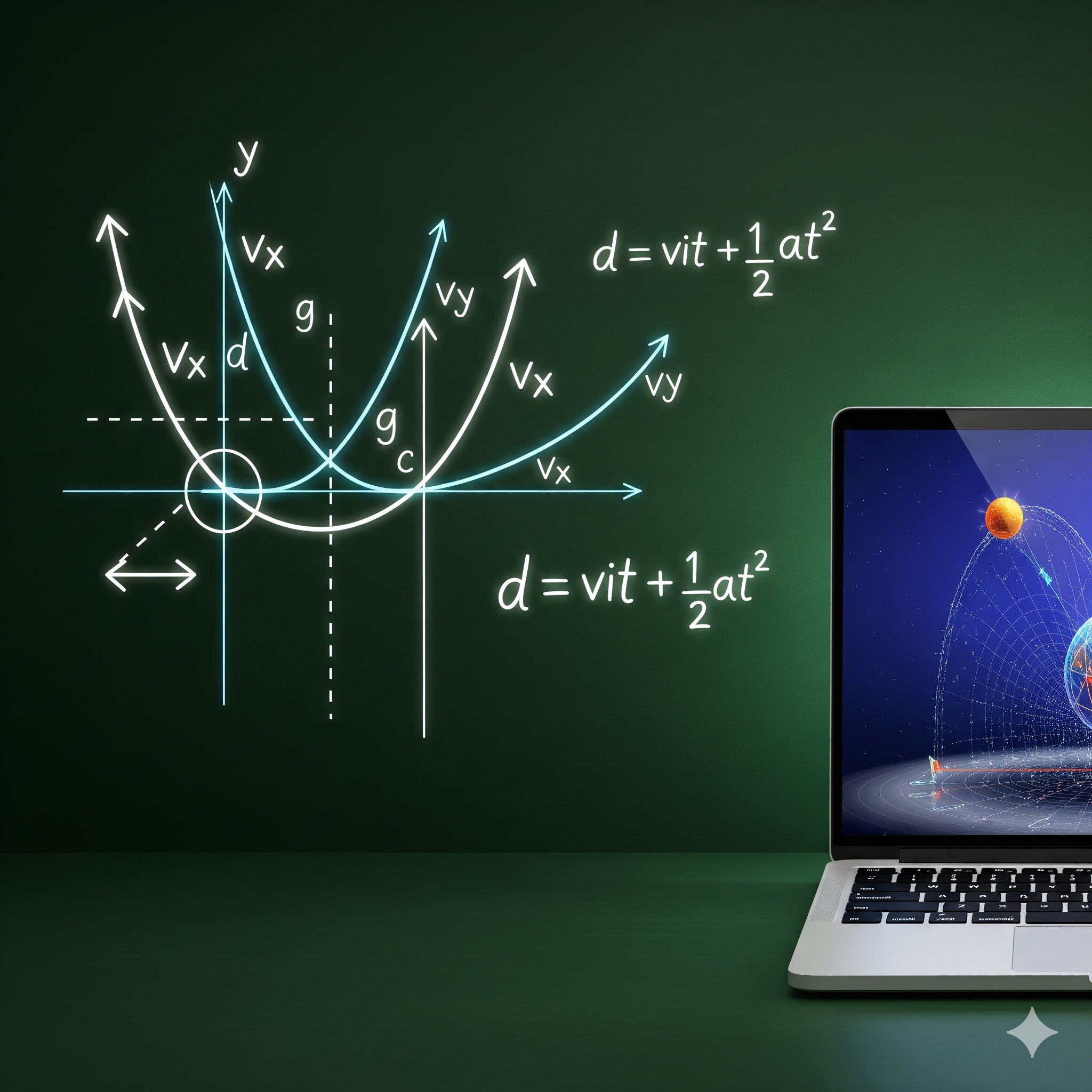
Mastering Projectile Motion: Cracking the “Wall” of Physics 12
For many high school students in British Columbia, Physics 12 starts with a bang—literally. You’ve moved past the simple “car driving down a straight road” problems of Physics 11 and entered the complex world of 2D Kinematics, specifically Projectile Motion.
At Dr. Shreyank Educare, we often see students hit their first “academic wall” here. Projectile motion isn’t just about plugging numbers into a formula; it’s about a fundamental shift in how you visualize physical movement.
Why is Projectile Motion the “Physics 12 Wall”?
In the BC New Curriculum for Physics 12, the focus shifts toward inquiry and deep understanding. Projectile motion is the first time students must juggle two independent dimensions—horizontal ($x$) and vertical ($y$)—simultaneously.
The Three Common Pitfalls:
- Mixing the Axes: Trying to use vertical acceleration ($g = -9.8 m/s^2$) in a horizontal calculation.
- Vector Resolution Errors: Misusing $sin$ and $cos$ when breaking down the initial launch velocity.
- The “Time” Bridge: Forgetting that Time ($t$) is the only variable that exists in both dimensions.
The Secret: The Independence of Motion
The most important concept to master in 2D Kinematics is that horizontal motion and vertical motion do not affect each other. * Horizontal ($x$): There is no acceleration (ignoring air resistance). The velocity is constant.
- Vertical ($y$): Gravity is constantly pulling the object down. This is essentially a Physics 11 “free-fall” problem.
By treating these as two separate problems connected only by the “Time Bridge,” the most complex word problems become manageable.
Step-by-Step: The Dr. Shreyank Deconstruction Method
At our After-School Math and Science Program, we teach a specific “Deconstruction” technique to help students navigate these problems without getting overwhelmed:
1. Draw the Vector Diagram
Always start by breaking your initial velocity ($v_i$) into components:
- $v_{ix} = v_i \cos(\theta)$
- $v_{iy} = v_i \sin(\theta)$
2. The T-Chart Strategy
Create a table with two columns: Horizontal and Vertical. List your knowns ($v, a, d, t$) in each. This prevents you from accidentally mixing up your $x$ and $y$ variables.
3. Solve for Time
Since $t$ is the same for both, use the column with the most information to find the time in the air. Once you have $t$, you can cross the “bridge” to solve for range or height.
Beyond the Textbook: Why Tutoring Makes the Difference
Projectile motion is a “Big Idea” that serves as the foundation for Circular Motion and Electromagnetism later in the year. If a student struggles here, the rest of Physics 12 can feel like an uphill battle.
Whether you are a student at Burnaby North, Moscrop, or studying remotely across Canada, our Online Tutoring platform provides the one-on-one focus needed to turn these abstract concepts into second nature.
How We Help:
- Real-world Visualization: We use simulations to show how vectors change in real-time.
- Exam-Specific Prep: Practice with past BC provincial-style questions and Final Exam Review Courses.
- Supportive Environment: A safe space to ask “Why?” until the logic clicks.
Ready to Ace Your Physics 12 Exams?
Don’t let 2D Kinematics slow you down. Join the best math and science tutoring program in Burnaby and Vancouver.
[Contact Dr. Shreyank Educare Today]
- Call/Text: +1 672-514-7587
- Email: info@drshreyankeducare.com
- Location: 2088 Madison Avenue, Burnaby, BC
- Website: Explore our Programs
Looking for more help? Check out our guide on Mastering Calculus for Physics Students.